Selecting the right sealing element depends on several technical factors. The more precise information provided already at the inquiry stage, the faster it is to determine the correct profile, material and possible method of manufacturing the part.
The most useful data are: installation dimensions, working medium, operating temperature, pressure, type of motion and the expected sealing function. In many cases these details alone allow a preliminary selection of an appropriate solution or indicate which additional data should be provided.
1. Installation dimensions
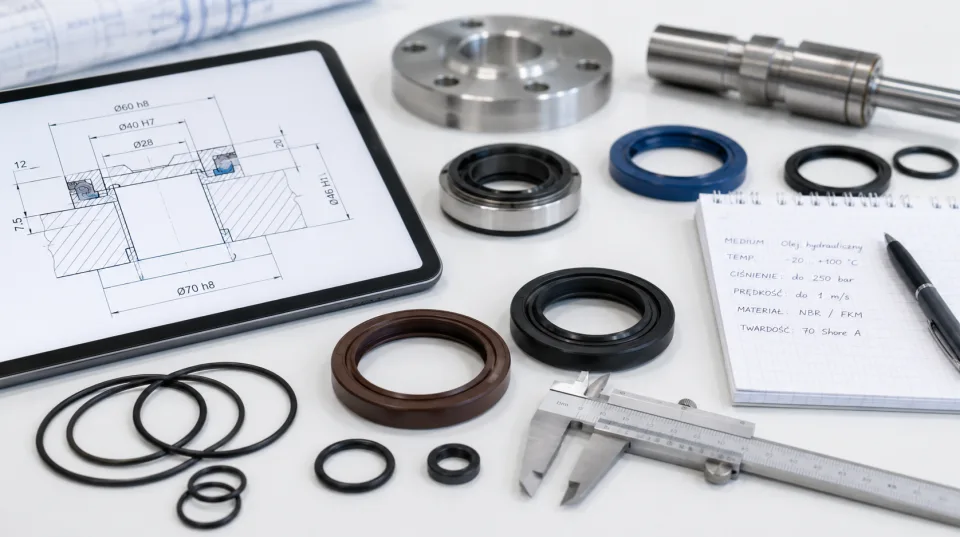
The basis for selecting a seal are the dimensions of the location where the element will operate. Depending on the application type, these may include, among others:
- diameter of the shaft, piston rod or bore,
- external diameter of the housing/seat,
- groove width,
- groove depth,
- installation height,
- assembly clearance,
- available working space.
It is worth providing not only the dimension of the worn seal itself, but also the dimensions of the seat in which it was installed. A used part may be stretched, deformed, swollen or partially worn, so measuring only the seal is not always sufficient.
2. Working medium
Another important piece of information is the medium with which the seal will be in contact. This may be, for example:
- hydraulic oil,
- grease,
- water,
- steam,
- air,
- fuel,
- coolant,
- chemicals,
- food products,
- detergents or cleaning agents.
The medium directly affects material selection. Not every elastomer or engineering plastic is suitable for contact with oil, aggressive chemicals, high temperature or food. For chemical substances it is useful to provide the most accurate possible name of the medium, its concentration and the operating temperature.
3. Operating temperature
Temperature is one of the key parameters when choosing a material. Specify both the steady operating temperature and any temporary temperature spikes, if present.
For example, different materials are used at room temperature, others for hot water or steam, and others for low-temperature applications. High temperature can accelerate rubber ageing, loss of elasticity, cracking or permanent deformation of the seal.
In the inquiry it is useful to provide:
- minimum operating temperature,
- maximum operating temperature,
- temporary temperature peaks, if any,
- frequency of temperature changes.
4. Operating pressure
Pressure affects the choice of seal profile, material hardness and the possible need for support rings. Excessive pressure with an incorrectly selected seal may cause extrusion of the material into gaps, accelerated wear or complete loss of sealing.
It is useful to provide:
- operating pressure,
- maximum pressure,
- whether pressure spikes occur,
- whether the application is static or dynamic.
5. Type of motion
A seal can operate under different motion conditions. The most common are:
- static operation,
- reciprocating motion,
- rotary motion,
- oscillating motion,
- slow or fast movement,
- intermittent or continuous operation.
The type of motion matters for selecting the profile, material and the finish of mating surfaces. A different solution is suitable for a rotating shaft, another for a hydraulic cylinder, and another for a static connection.
6. Sealing function
In the inquiry it is useful to specify what function the element should perform. A seal may be responsible for, among other things:
- retaining the medium inside the system,
- protection against external contamination,
- wiping contaminants from a piston rod,
- guiding moving components,
- supporting the seal at high pressure,
- separating two media,
- protecting against dust, water or particles.
With this information it is quicker to determine whether an O-ring, oil seal (simmering), piston seal, rod seal, wiper, guide ring, support ring or a custom part is needed.
7. Photo, technical drawing or worn part
If a worn part, photo or technical drawing is available, it is worth attaching it to the inquiry. Even a simple phone photo can help identify the profile type, mounting method and possible material.
Preferably send:
- photos of the part from several sides,
- a photo of the cross-section if the part is cut,
- a photo of the installation location,
- technical drawing with dimensions,
- markings found on the old seal,
- information about the machine or equipment in which the part operates.
If the seal is non-standard, damaged or heavily worn, a drawing of the installation or measurements of the seat can be particularly helpful.
8. Working conditions in demanding applications
In more demanding applications the working conditions should be described in greater detail. This applies especially to industries such as:
- chemical industry,
- food industry,
- pharmaceuticals,
- hydraulic systems,
- pneumatics,
- agricultural and construction machinery,
- high-temperature installations,
- systems subject to frequent washing or sterilization.
In such cases it is also useful to provide the duty cycle, frequency of stops, cleaning method, cleaning agents used and information whether the part must meet additional requirements, for example food-contact suitability.
9. Quantity and delivery method
It is also worth adding information about the required quantity to the inquiry. The selection and pricing of a single emergency part differs from that for serial production or regular deliveries.
Useful information includes:
- number of pieces,
- whether the inquiry concerns a one-off need or regular supplies,
- required lead time,
- whether a substitute part is acceptable,
- whether the part must conform to existing documentation or a sample.
10. What to do if we don’t know all parameters?
Not all data is always available. In such a situation it is worth sending what you can: photos, approximate dimensions, a description of the machine, a description of the problem and information about the working conditions. Based on that it is possible to determine which parameters are critical and which measurements still need to be taken.
It is often also helpful to describe the problem, for example:
- the seal is leaking,
- the part wears out quickly,
- the seal cracks,
- the material swells,
- the part falls out of the seat,
- there is excessive friction,
- the seal does not withstand the temperature or chemicals.
Such a description allows not only selecting a replacement, but sometimes also identifying the root cause of the failure.
Summary
For a sealing inquiry it is best to prepare basic technical data: installation dimensions, medium, temperature, pressure, type of motion and the expected function of the element. If a worn part, photo, marking or technical drawing is available, include it.
A complete set of information shortens the selection time, facilitates choosing the right material and reduces the risk of using an inappropriate profile. In demanding applications, such as chemicals, food industry or high-temperature systems, particularly important is a precise description of the working conditions and the cleaning method of the installation.
Need help selecting a seal?
Send medium, dimensions and operating conditions. We will prepare material selection guidance and execution options.