Introduction: why seals in contact with steam require attention
Steam is a common medium in the power, chemical and food industries. Higher temperature, condensation on surfaces and the presence of contaminants cause seals operating in steam environments to degrade faster. Choosing the seal material and design should take process parameters, installation conditions and expected service life into account.
Degradation mechanisms of seals under the influence of steam
The most common phenomena affecting durability are:
- hydrolysis and softening of polymer materials at elevated temperature and humidity,
- swelling of elastomers due to absorption of water or condensate,
- oxidation and thermal ageing at high temperatures,
- abrasion and wear of sliding surfaces in mechanical seals, especially in the presence of contaminants,
- corrosion of metallic components due to condensate and chemical constituents in the steam.
Material options used in steam seals
In industrial practice the following material groups are most often considered. Each solution requires verification according to the specific operating conditions.
- PTFE (polytetrafluoroethylene) — commonly used where good thermal resistance and low adhesion are needed. It can be considered for dry and saturated steam but must be checked for high temperatures and pressures.
- Graphite and laminated graphite — suitable for higher temperatures and in the presence of condensation; often used in packings and ring seals. Requires assessment regarding brittleness and chemical compatibility.
- Elastomers (FKM, EPDM, silicone) — EPDM is frequently considered for resistance to steam, silicone can offer good temperature resistance; FKM may be used depending on steam composition and temperature. Elastomer choice requires verification of mechanical properties and long-term exposure to steam.
- Composite materials and carbides — used for friction surfaces of mechanical seals; selection of mating friction materials (e.g., silicon carbide / silicon carbide, graphite/ceramic) should consider temperature and contaminants.
Types of seals suitable for steam service
- ring seals (O-rings, flat gaskets) — simple to install, suitable for moderate conditions,
- gland and lip seals — used where relative movement occurs and leakage control is required,
- packing seals — often used at high temperatures and on valves/steam joints,
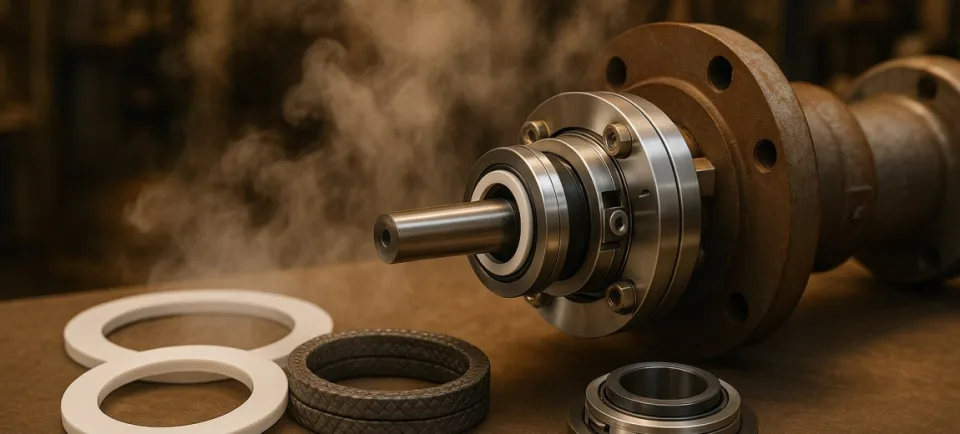
- mechanical seals (mechanical seals) — preferred for rotating shafts and where low steam loss is required; selection of seal faces and abrasive materials requires detailed analysis.
Selection criteria for seals in steam environments
When selecting a seal, consider the following parameters:
- operating temperature (min./max. range),
- operating pressure (static and transient),
- degree of steam saturation and presence of condensate,
- relative motion (rotational speed, motion amplitude, cycle frequency),
- friction values and lubrication of the sealing zone,
- chemical composition of the steam (contaminants, pH, presence of combustion products),
- installation requirements and available space for the seal,
- expected service life and maintenance intervals.
Symptoms of wear and seal failures in steam systems
Regular inspections allow detection of typical wear symptoms that may indicate the need for intervention:
- steam or condensate leaks,
- temperature rise in the sealing area,
- increased friction or resistance to movement (in rotating equipment),
- swelling, cracking or crumbling of sealing material,
- unusual noises (rubbing, impacts) and vibrations,
- accelerated wear of adjacent components (flanges, valve stems).
Risks and consequences of improper selection
- personnel safety hazards from hot steam leaks,
- production downtime and repair costs,
- corrosion and damage to structural elements caused by condensate,
- contamination of the process medium,
- energy losses associated with leaks.
Maintenance, inspection and good operating practices
Recommended operational approaches (require adaptation to working conditions):
- regular leak checks and visual inspection of seals,
- monitoring temperature and vibration at critical points,
- use of steam traps and condensate drains,
- use of flushing or barrier (purge) systems on mechanical seals,
- proper installation maintaining tolerances and manufacturer instructions and avoiding contamination during assembly,
- planned replacements and spare parts inventory for critical points.
Data required for a request for quotation — checklist
The information below will help prepare an offer and choose an appropriate solution:
| Parameter | Example / note |
|---|---|
| Operating temperature (min / max) | e.g. 60°C - 220°C |
| Operating pressure (bar or MPa) | static pressures and short-term impulses |
| Type of steam | saturated / superheated, dryness fraction |
| Composition and contaminants | presence of soot, oils, chemicals |
| Installation dimensions | shaft Ø, thicknesses, clearances, technical drawings |
| Rotational speed / motion frequency | rpm or mm/s, duty cycles |
| Leakage requirements | maximum allowable leakage |
| External environment | ambient temperature, humidity, corrosion |
| Existing materials | current seal, coatings, flanges |
| Quantity and delivery timing | number of pieces, lead times and priorities |
The more complete the data provided in the inquiry, the greater the chance of selecting an optimal solution. Drawings and photos facilitate verification.
Example solutions and practical recommendations
- where steam is dry and clean — consider PTFE or composites; where condensate occurs — graphite or special composites,
- for rotating shafts at higher temperatures — consider mechanical seals with appropriate face materials,
- use of barriers and purge systems can significantly extend the life of mechanical seals,
- where possible, limit elastomer contact with condensate or chemicals by using PTFE or graphite linings,
- when modernizing installations, consider leakage monitoring systems and thermography during planned inspections.
Summary and contact
Seals intended for operation in steam conditions require a holistic approach: material selection, design and operating practices should be based on specific process parameters. Kragum Sp. z o.o. can assist in analysis and preparing an offer — feel free to contact us and send the complete set of data listed above. Every solution requires verification under operating conditions.
Need help selecting a seal?
Send medium, dimensions and operating conditions. We will prepare material selection guidance and execution options.