Introduction — why seals in cylinders matter for the production process
Hydraulic seals in cylinders are responsible for maintaining operating pressure, isolating the working space from contaminants, and controlling flows. Poor seal condition can lead to disturbances in the production cycle — from reduced precision to complete stoppages. This text aims to present practical inspection methods, typical failure symptoms, and the data needed for quick diagnosis or a request for quotation.
The role of seals in cylinder operation — what to monitor
In the context of maintenance, the key functions of seals are: pressure retention, leak minimization, environment separation (e.g. oil–atmosphere), and compensation for clearances. During inspection it is worth focusing on parameters that directly affect motion quality and operation repeatability.
- Hydraulic leakage — degree and location of the leak (external or internal).
- Pressure and speed stability — fluctuations during the work cycle.
- Condition of the rod and cylinder surfaces — scratches, burns, corrosion, excessive wear.
- Oil contamination — presence of metal particles, water or other contaminants.
Typical seal failures and mechanisms of their occurrence
Seals degrade for many reasons. Understanding the failure mechanism makes it easier to select appropriate repair actions.
- Abrasion — caused by the presence of contaminants or incorrect surface roughness.
- Material degradation — thermal and chemical effects of the hydraulic fluid or working conditions.
- Mechanical damage — scratches, cuts during assembly, improper guiding elements.
- Fatigue and loss of elasticity — as a result of repetitive cycles and aging.
Symptoms of production process disturbances resulting from seal damage
In a production facility disturbances can be direct (e.g. a leak) or indirect (e.g. poorer product quality). Early recognition of symptoms reduces the risk of production interruptions.
- Unstable extension/retraction speed, motion oscillations.
- Slow sinking or spontaneous movement of the rod with the system turned off.
- Visible oil stains around joints and guides — external leaks.
- Elevated temperatures at hydraulic components.
- Contamination of the work environment (oil splashes, deposits on the product).
- Increased energy consumption or more frequent emergency shutdowns.
Risks associated with ignoring seal condition
Lack of diagnostic and preventive actions can result in:
- An increase in the number of non-conforming products.
- Damage to the rod, cylinder or valves (due to contamination).
- Longer service downtimes and higher repair costs.
- Increased risk of environmental leaks and HSE problems.
Methods and procedures for inspecting seal condition
Systematic inspection combines visual checks with measurements. Below is a set of practical actions to apply on the production line and in the workshop.
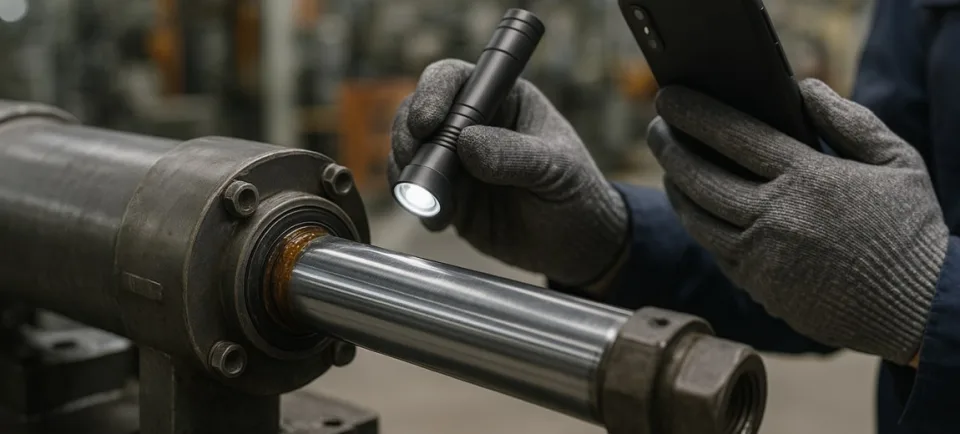
- Visual inspection: check seals, the rod surface and the surrounding area for damage and contamination.
- Leak test: observe pressure drop in a closed circuit, requires verification of system parameters.
- Quantitative measurements: measurement of leaks, operating pressure during the cycle, extension speed.
- Oil analysis: testing for contaminants and physico-chemical parameters, depending on available tests.
- Data recording: log measurement results in the CMMS or control sheet.
Tools and instruments helpful in diagnostics
A basic tool set allows a quick assessment of seal condition without disassembling the entire system.
- Pressure gauges and recorders.
- Contact thermometers and thermal cameras (for detecting local overheating).
- Flow measurement devices and probes to assess internal leaks.
- A set of micrometers and instruments for measuring surface roughness.
- Filters and oil samples for laboratory analysis.
Data required for a service request or a seal replacement quote
For a quick service response or when ordering replacements, it is important to prepare a complete set of information. The list below helps speed up the diagnostic and quotation process.
- Type and manufacturer of the cylinder (if known) and the catalogue number.
- Dimensions: cylinder bore, rod diameter, stroke.
- Type and parameters of the hydraulic fluid (designation/density/viscosity), operating temperature.
- Maximum and typical operating pressure and the load profile (e.g. shocks, cycle frequency).
- Mounting method and guide arrangement (single-sided/double-sided arrangement, enclosed/open).
- Photos of the sealing area, rod and any collected leakage.
- History of repairs and maintenance activities, seals previously used.
- Production requirements regarding allowable leakage and cycle repeatability.
Practical checklists and a sample inspection schedule
| Action | Typical frequency | Purpose |
|---|---|---|
| Visual inspection of seals | daily / before shift | Detect visible leaks and damage |
| Pressure measurements and cycle recording | weekly / after parameter changes | Evaluate operational stability |
| Oil analysis and filtration | monthly / after a failure | Detect contaminants affecting seal wear |
| Surface roughness measurements and condition checks | during major overhaul | Assess adhesion and material compatibility of seals |
Recommended actions when a failure is detected — quick steps
If abnormalities are detected, actions that minimize production and safety impacts are recommended.
- Secure and mark the leak area; if the leak affects product quality, stop the cycle and isolate the batch.
- Collect oil samples and perform basic measurements (pressure, temperature, movement speed).
- Contact the service department or seal supplier, providing complete data and photos.
- If necessary, apply temporary measures (covers, absorbents, pressure reduction), remembering safety and compliance with the equipment manufacturer's recommendations.
Summary and recommendations for maintenance and procurement departments
Regular inspection of seals in cylinders is often an undervalued element of ensuring production process stability. Systematic inspections, data recording and prompt transmission of complete information to service or supplier help reduce downtime and repair costs. When planning actions, consider local working conditions and require verification of proposed solutions by technical services or the machine manufacturer.
A good diagnostic process is not just seal replacement — it is analysis of causes, monitoring of operating parameters and implementation of preventive changes that minimize repeat failures.
Need help selecting a seal?
Send medium, dimensions and operating conditions. We will prepare material selection guidance and execution options.