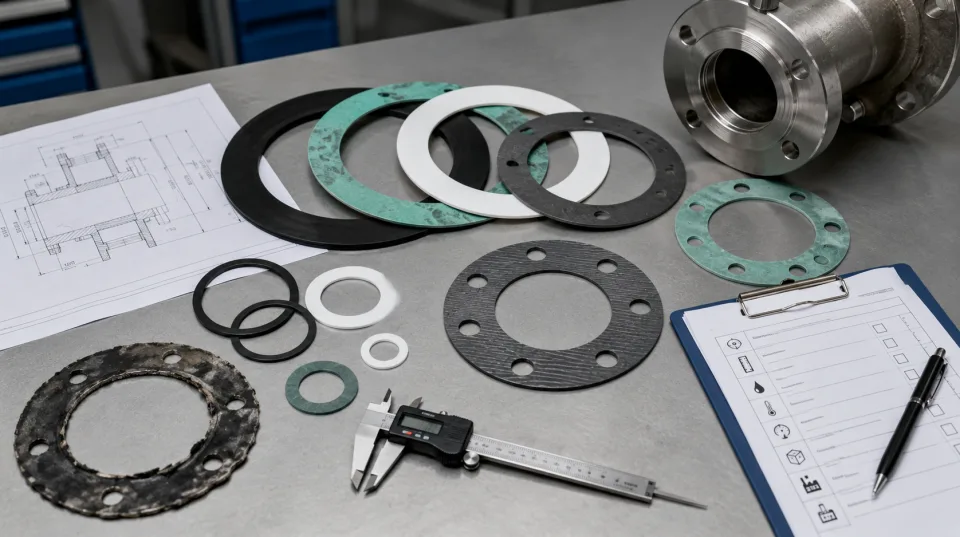
Flat gaskets are a commonly used sealing element in flange joints, covers, pumps and heat exchangers. Choosing the right material and construction has a direct impact on leak tightness, process safety and operating costs. Below are practical guidelines to help select and diagnose flat gaskets in industrial environments.
Where flat gaskets are used
- Piped flange connections in steam, liquid and gas installations.
- Covers of tanks and process chambers.
- Housings for conveyors, pumps, gearboxes and valves.
- Heat exchangers and media transfer equipment.
- Systems where controlled deformation and repeatable bolt preload are required.
Basic material types
- Graphite (purified/expanded) — good thermal conductivity, temperature resistance; often used in steam applications, requires protection against delamination.
- PTFE (Teflon) — broad chemical resistance, low adhesion; may require reinforcement with fabric or metal at higher pressures.
- Elastomers (NBR, EPDM, FKM) — good flexibility and ability to compensate for surface irregularities; selection depends on the medium and operating temperature.
- Fibre mats and fibrous composites (e.g., aramid, glass fibre) impregnated with latex or rubber — economical solution for lower pressures and temperatures.
- Metallic composite and metal-with-graphite gaskets — used where higher temperature and mechanical resistance are required.
Material properties and selection criteria
When selecting a material consider the following parameters:
- Operating temperature range (min / max).
- Operating pressure and possible pressure surges.
- Chemical nature of the medium (corrosivity, presence of aggressive compounds, vapours).
- Flange surface type: roughness, hardness, geometry.
- Required tightness (e.g. steam vs inert gas).
- Permissible deformation and material modulus of elasticity.
- Service life and operating conditions and maintenance possibilities (replacement, inspections).
Standards and markings (practical notes)
In industrial practice, standards and norms specifying gasket dimensions and classes are used. The most common categories of standards cover flange types, dimensions, thickness tables and materials. Specific standards may vary between markets and industry sectors and should be verified before application. When requesting a quote, it is useful to indicate whether gaskets compliant with a specific standard are required.
Common signs of wear and causes of failure
- Leaks at the flange connection — possible causes: incorrect material, improper bolt tightening, mechanical damage.
- Permanent deformation (extrusion) — often due to too soft a material or prolonged exposure to high pressure.
- Brittleness and cracking — typical with material ageing, aggressive chemicals or exceeding temperature limits.
- Adhesion to the flange surface and damage during disassembly — possible with materials of high adhesion and lack of lubricants.
- Contact corrosion of the flange material — may result from improper selection of gasket material relative to the metal.
Risks associated with incorrect selection
- Loss of tightness leading to leaks and environmental hazards.
- Equipment damage and production downtime.
- Personnel safety risks with hazardous media or high temperatures.
- Excessive operating costs resulting from frequent replacements and repairs.
- Possible reactions between materials (e.g. elastomer degradation due to the medium).
How to select a flat gasket — practical process
- Identify operating conditions: temperature, pressure, medium, duty cycles.
- Determine the type of connection and flange dimensions (flange type, bolt hole pattern).
- Choose a material group that meets chemical and temperature requirements.
- Check compatibility with the flange surface and required roughness.
- Decide on the construction: full sheet, reinforced (metal/textiles), stiffening ring.
- Verify normative requirements and any acceptance tests required at the facility.
- Prepare a request for quotation with the complete set of data (see below).
Data needed for a request for quotation
When sending a request for flat gaskets, it is worth providing the following information:
- Type and drawing number or template of the flange (if available).
- Dimensions: outer diameter, inner diameter/hole, required gasket thickness.
- Type and size of the flange connection (e.g. PN/ANSI/DIN — if applicable).
- Operating temperature (min/max range) and conditions for short-term temperature shocks.
- Operating and maximum pressure (and information about pressure surges).
- Description of the medium (chemical composition, concentrations, presence of vapours, solid particles).
- Requirements for tightness (e.g. steam, LNG, technical gas) and acceptance criteria.
- Flange material and surface condition (roughness Ra, hardness, coatings).
- Replacement frequency/expected service life and material preferences.
- Quantity required and delivery lead time.
- Documentation requirements: material certificates, test reports, attestations (requires verification).
Alternative materials and substitutes — practical notes
- In many cases material substitutes are possible (e.g. PTFE instead of an elastomer), but they require compatibility tests with the medium and operating conditions.
- Using reinforced materials can increase pressure resistance but will change the deformation behaviour and bolt tightening characteristics.
- When switching to a substitute it is recommended to perform a pilot test and mounting verification.
Installation, bolt tightening and quality control
- Use a bolt tightening sequence in a cross pattern; recommended tightening torques should be verified for the specific connection.
- Control flange surface parameters: flatness and roughness affect sealing performance.
- Avoid over-tightening, which can lead to permanent extrusion and reduced gasket life.
- Storage and transport of gaskets should protect them from UV, ozone, oils and contamination.
- After installation, a leak check and scheduled inspections should be carried out at intervals appropriate to the process risk.
Summary and recommendations
Selection of a flat gasket should be based on analysis of operating conditions, material compatibility and tightness requirements. In practice an iterative approach is most common: preliminary material selection, dimensional verification and trial installation, followed by monitoring in operation. If in doubt, Kragum Sp. z o.o. can assist with technical analysis and preparing a request for quotation — the final selection always requires verification under operating conditions.
Contact us if you need support with material selection, flange surface measurement or preparing technical documentation.
Need help selecting a seal?
Send medium, dimensions and operating conditions. We will prepare material selection guidance and execution options.