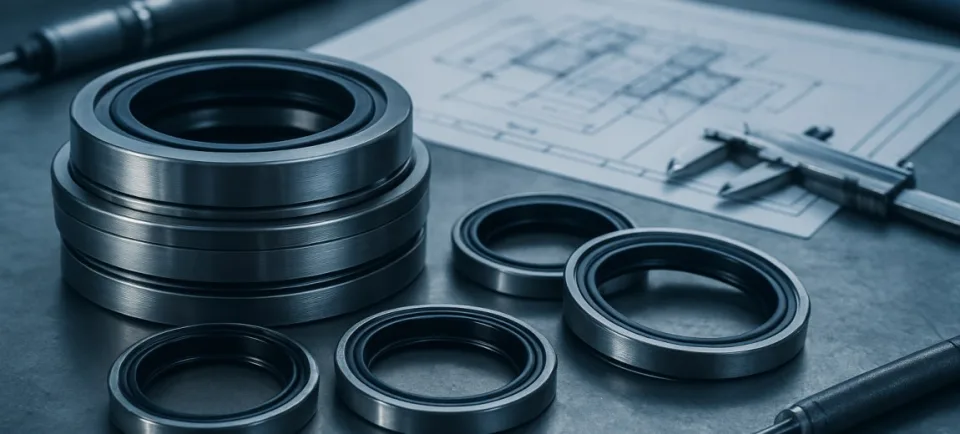
Turned seals (so‑called ring seals or labyrinth seals in a turned form) are a commonly used solution in rotating machines, gearboxes and drive shafts. This article discusses construction, materials, selection criteria, failure symptoms and practical data worth preparing when sending an inquiry.
## Construction and principle of operation
Turned seals typically consist of a sealing ring made of a soft or polymeric material mounted in a metal housing or integrated with the casing. The seal works by direct contact of the working surface with the shaft or with the mating surface, often with a small contribution from a spring or a pressure element.
## Materials and their properties (indicative)
The choice of seal material determines resistance to abrasion, chemicals, temperature and the coefficient of friction. The table below presents indicative properties — these require verification for the specific application.
| Material | Indicative properties |
|---|---|
| Elastomers (e.g. NBR, FKM) | Flexible, good at low and moderate speeds; often used with mineral oils and standard operating conditions; chemical resistance depends on the elastomer type. |
| PTFE and composites | Low coefficient of friction, high chemical resistance; may be considered for higher temperatures and aggressive media; compatibility assessment is required. |
| Reinforced materials (graphite, fibers) | Higher resistance to wear and temperature; often used in more demanding conditions, but require verification regarding cooperation with the shaft surface. |
## Typical applications
- Drive and auxiliary shafts in rotating machines
- Pumps and gearboxes, drive systems
- Machines for processing plastics and metals
- Systems where low friction and long-term rotational operation are required
## Technical parameters for selection
When selecting a turned seal, several parameters must be considered. The list below contains critical data that affect the seal's durability and effectiveness:
- Shaft diameter (d) and bore/housing diameter (D), dimensional tolerances
- Width of the ring/seal
- Rotational speed (rpm) and surface linear speed at the working surface
- Pressure on the sealed side and occurrence of pressure pulsations
- Operating temperature (working range and short-term peak values)
- Type and properties of the medium (oils, water, emulsions, chemicals) — concentrations and contaminants
- Shaft surface roughness (Ra), type of coating and surface hardness
- Required mounting directions and possibility of axial/lateral compensation
- Allowable wear and service requirements
## Symptoms of wear and common failures
Early recognition of symptoms reduces the risk of accompanying damage. Characteristic signs include:
- Visible leaks at the shaft and housing interface
- Increased friction or heating of the shaft/seal
- Increased torque and energy consumption
- Build-up of deposits, scratches or transfer of material from the seal onto the shaft
- Contamination of the working environment (oil or emulsion leaks)
- Vibrations or noise coming from interacting components
## Risks of incorrect selection
- Ingress of contaminants into bearings and other components, which can shorten their service life
- Excessive overheating of the seal and material degradation
- Increased operating costs and production downtime
- Possibility of leaks and environmental hazards
- Damage to the shaft surface (scratches, deformations) with inappropriate mating geometry
## Installation and best practices
Correct installation significantly affects seal life. Recommended practices include:
- Checking dimensions and tolerances before installation
- Cleaning the shaft surface of oil, dirt and burrs
- Using installation tools that prevent damage to the seal edges
- Checking coaxiality and assembly clearances
- Verifying direction and operating conditions after start-up, monitoring temperature and leaks
## Maintenance, service and replacement
Planning replacement based on condition reduces downtime. Service tips:
- Visual inspection during routine checks
- Measuring temperature and torque as wear indicators
- Replacing together with cooperating components (e.g. retaining rings, springs) if deformations are found
- Documenting operating conditions and service life for future selections
## Data required for a request for quotation
When ordering a turned seal, it is helpful to provide the following information — this will facilitate preparing an accurate offer and shorten selection time:
1. Dimensions: shaft diameter (mm), bore/housing diameter (mm), seal width (mm), tolerances
2. Rotational speed (rpm) and linear speed at the contact surface
3. Operating temperature (range and maximum values)
4. Pressure on the sealed side and occurrence of pressure impulses
5. Type of medium, its composition and possible contaminants (e.g. abrasive particles, suspensions)
6. Shaft surface: Ra, coatings, hardness, any damage
7. Quantity and required delivery dates
8. Installation and service requirements (easy disassembly, access to the mounting location)
9. Information about previous seals and observed problems
Preparing the above data allows us at Kragum Sp. z o.o. to more quickly carry out an analysis and propose materials and seal constructions that may be considered for the given application. Final selection and confirmation of material resistance require tests or detailed verification of operating conditions.
Technical consultation
Request a quote
Need help selecting a seal?
Send medium, dimensions and operating conditions. We will prepare material selection guidance and execution options.