## Why a photo of the seal alone is not enough for a proper quote?
A photo of the seal is very helpful for an initial identification of the part, but most often **it is not sufficient for a correct quotation and selection of a replacement**. From a photograph you can sometimes determine the general type of seal, its shape or wear pattern, but you cannot reliably confirm all technical parameters.
In practice, two seals can look almost identical yet differ in material, hardness, dimension, profile, tolerance, chemical resistance or intended application. Therefore, when making an inquiry it is worth sending not only a photo but also basic technical data about the part and the operating conditions.
## 1. A photo shows the shape but not the dimensions
The biggest limitation of a photo alone is the lack of an accurate scale. Even a high-quality photograph does not allow precise determination of inner diameter, width, profile height, groove depth or assembly clearances. Perspective, shooting angle and lens distortion can further hinder assessment.
For pricing a seal you will typically need:
- inner diameter,
- outer diameter,
- height or width of the seal,
- dimensions of the mounting groove,
- diameter of the shaft, rod or bore,
- information whether the provided dimension is taken from the seal itself or from the housing.
In the case of worn seals, measuring the part itself may also be insufficient, because rubber, polyurethane or plastic may have deformed during operation.
## 2. A worn seal can have an altered shape
A seal removed from a machine often no longer has its original dimensions and shape. It may be stretched, flattened, swollen, hardened, cracked or partially worn. On a photo such a part can look like a standard profile even though its geometry has been changed by operating conditions.
Typical changes visible after disassembly include:
- flattening of the sealing lip,
- increase in diameter due to stretching,
- reduction of profile height,
- material swelling under the influence of the medium,
- losses on working edges,
- deformation from incorrect installation,
- signs of operation under excessive pressure.
Therefore, when selecting a seal it is important not only to have a photo of the old element but also information about the mounting location and housing dimensions.
## 3. The photo does not show the material
One of the most common mistakes is trying to identify the material solely by the color or appearance of the seal. A black seal is not necessarily made of NBR, and brown, green, red or white color does not guarantee a specific material.
Seals can be made from, among others:
- **NBR**,
- **FKM**,
- **EPDM**,
- **VMQ / silicone**,
- **PU**,
- **PTFE**,
- **POM, PA, PEEK** or other engineering plastics.
Each of these materials has different properties. Differences concern resistance to oils, water, steam, fuels, chemicals, temperature, friction and abrasion. Without information about the material or operating conditions it is difficult to prepare a responsible quotation.
## 4. Appearance does not reveal the working medium
The working medium directly affects material selection. A photo does not show whether the seal worked with hydraulic oil, water, steam, fuel, grease, process chemicals, detergent or a food product.
This information is crucial because the same seal profile may require a completely different material depending on the working environment. For example, a material suitable for mineral oil may not perform well in steam, fuel or a cleaning agent.
When inquiring, it is worth providing:
- the type of working medium,
- the exact name of the substance or product,
- the medium concentration, if applicable,
- whether contact with the medium is continuous or intermittent,
- information about flushing, washing or medium changes in the work cycle.
## 5. A photo does not show temperature and pressure conditions
Temperature and pressure are additional parameters that cannot be assessed from a photograph. They have great significance for seal durability. A material that performs well at room temperature may quickly harden, lose elasticity or degrade at elevated temperature.
At high pressure it may be necessary to use a different profile, a different material hardness or an additional support ring. Without this information the quotation may be incomplete or based on incorrect assumptions.
The most important data are:
- minimum temperature,
- maximum temperature,
- transient/peak temperature,
- working pressure,
- maximum pressure,
- information about pressure spikes.
## 6. The type of motion changes seal requirements
A static seal, rod seal, piston seal and rotary shaft seal can look similar in a photo but operate under completely different conditions. They differ in friction, lubrication, speed, load and the way they contact the mating surface.
When inquiring, specify whether the seal operates:
- statically,
- in reciprocating motion,
- in rotary motion,
- in oscillating motion,
- in continuous operation,
- intermittently.
In dynamic applications resistance to abrasion, friction coefficient, lubrication and the condition of the mating surface are more important.
## 7. One profile can have many variants
A photo often shows only the general profile shape. In practice the same seal type may be available in several material variants, hardnesses, dimensions and construction versions.
Differences can concern, among others:
- the sealing material,
- hardness of rubber or polyurethane,
- presence of a spring,
- number of sealing lips,
- shape of the working edge,
- type of support ring,
- manufacturing tolerance,
- intended application.
Therefore, for more critical applications it is worth including a technical drawing, manufacturer marking, catalog number or photos of the part from multiple angles.
## 8. A photo does not always allow distinguishing the seal type
Some seals are visually very similar. This is especially true for hydraulic and pneumatic components where different profiles can look alike after disassembly.
It can be problematic to distinguish from a photo, for example:
- a piston seal from a rod seal,
- a single-sided profile from a double-sided one,
- a primary seal from a wiper,
- a guide ring from a support ring,
- a rubber seal from a plastic element,
- a standard profile from a special design.
In such situations a photo of the entire assembly or information about where in the machine the part worked is very helpful.
## 9. What to send instead of a single photo?
The best inquiry contains both a photo and the technical data. This allows faster identification of the part, appropriate material selection and preparation of a more precise quotation.
It is worth sending:
- photos of the seal from several sides,
- a photo of the profile cross-section if possible,
- a photo of the mounting location,
- dimensions of the seal,
- housing/groove dimensions,
- information about the material, if known,
- the type of working medium,
- operating temperature and pressure,
- the type of motion,
- the machine or equipment type,
- quantity to be quoted,
- whether a replacement, a standard version or custom production is needed.
## 10. How to take a good photo of the seal?
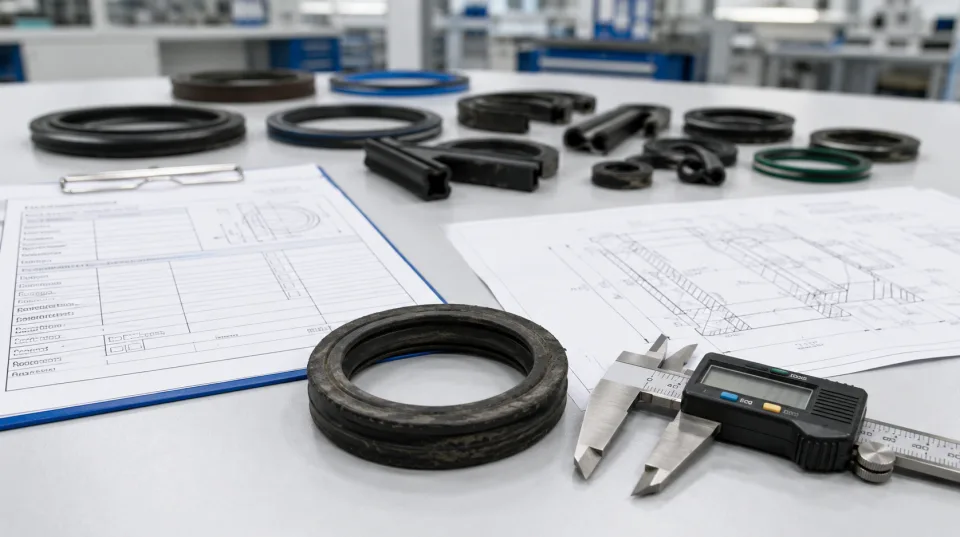
If a photo is to help with pricing, it should be taken as clearly as possible. Photograph the part on a light background, without strong shadows and without covering the working edges.
Particularly useful are:
- a top-down photo,
- a side photo,
- a photo of the profile cross-section,
- a photo with a visible ruler or caliper,
- a photo of any markings, if present,
- a photo of the mounting place after disassembly of the seal.
For very small parts take a close-up photo while keeping focus and avoiding shape distortion.
## 11. Why full data speed up the quotation?
The more technical information provided at the start, the fewer additional questions will be needed during the preparation of the offer. Complete data make it quicker to determine whether the part is available as a standard item or requires custom production.
Accurate information also reduces the risk of incorrect selection. This matters especially when the seal works in harsh conditions, at high pressure, with an aggressive medium or in an application where machine downtime generates high costs.
## Summary
A photo of the seal alone can be a good starting point but usually is not enough for a correct quotation. A photograph helps assess the general shape of the part, however it does not show exact dimensions, material, hardness, working medium, temperature, pressure or type of motion.
To select and price a seal as precisely as possible, it is best to provide: **a photo, dimensions, housing data, medium, temperature, pressure, type of operation and information about the machine or equipment**. This set of data reduces the risk of error and enables a faster preparation of an appropriate offer.
Technical consultation
Request a quote
Need help selecting a seal?
Send medium, dimensions and operating conditions. We will prepare material selection guidance and execution options.