##
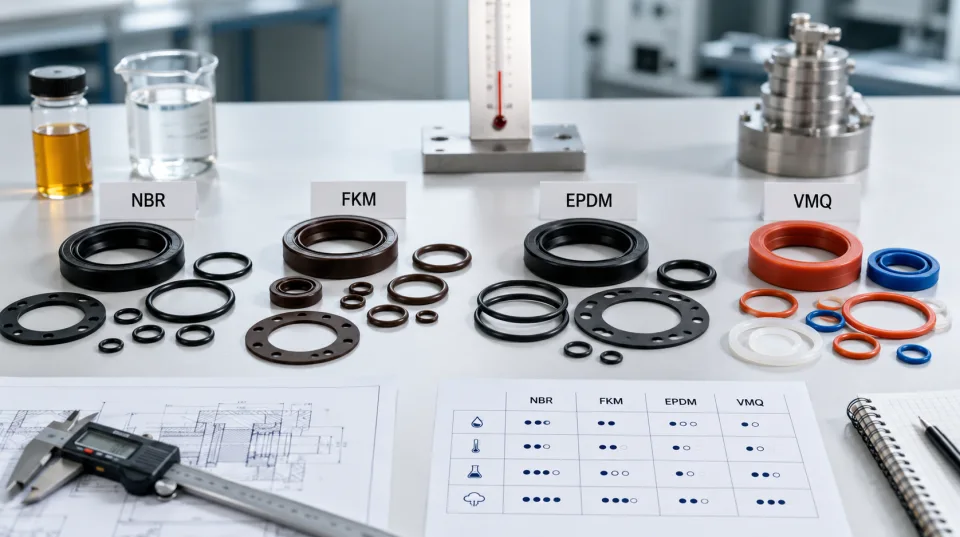
The selection of a technical seal very often starts with dimensions, but the durability of the component is largely determined by the **rubber material**. The most commonly encountered designations include **NBR, FKM, EPDM and VMQ**. Each of these materials has different properties, different resistance to working media and different application ranges.
The same type of seal may look similar, but depending on the material it will behave completely differently in contact with oil, water, steam, fuel, temperature, grease or chemical agents. Therefore, when selecting a seal, knowing only its shape and dimension is not enough.
## 1. Why does rubber material matter?
The seal material determines resistance to the working medium, temperature, deformation, ageing, abrasion and operating conditions. If the material is selected incorrectly, the seal can quickly lose its properties.
Typical signs of an incorrectly selected material include:
- swelling of the seal,
- hardening of the rubber,
- loss of elasticity,
- surface cracking,
- dimensional change,
- delamination or crumbling,
- excessively fast wear,
- loss of tightness after a short operating time.
For this reason, when inquiring about a seal it is worth providing not only the dimension but also the medium, temperature, pressure, type of motion and the working characteristics of the system.
## 2. NBR — a common rubber for oils and standard applications
**NBR**, i.e. acrylonitrile-butadiene rubber, is one of the most commonly used rubber materials in sealing technology. It is popular due to its good resistance to mineral oils, greases and many standard industrial media.
NBR seals are often used in:
- hydraulic systems,
- pneumatics,
- industrial machinery,
- cylinders,
- oil systems,
- standard O-rings,
- oil seals (simmerings) and technical seals.
NBR is a good choice for many oil applications, but it is not a universal material. Depending on the compound it may have limited resistance to ozone, weathering, high temperature and some chemicals.
## 3. FKM — for higher temperatures, fuels and demanding media
**FKM** is a fluoroelastomer, often associated with seals operating at higher temperatures and in contact with fuels, oils and selected chemical media. Compared with NBR it usually offers better temperature and chemical resistance.
FKM seals are commonly used where standard rubber may age or degrade too quickly. This includes applications with elevated temperature, fuels, synthetic oils and more demanding working environments.
FKM is used, among others, in:
- fuel systems,
- oil applications at higher temperatures,
- the chemical industry,
- automotive applications,
- industrial machinery,
- seals operating in harsher conditions.
However, it is worth remembering that FKM is not suitable for every medium. In some water or steam applications, or with certain chemicals, another material may be a better choice.
## 4. EPDM — for water, steam and weathering
**EPDM** is ethylene-propylene-diene rubber. It is often chosen for applications related to water, hot water, steam and atmospheric conditions. It also performs well where resistance to ozone and ageing is important.
EPDM is often used in:
- water installations,
- hot water systems,
- selected steam applications,
- external seals,
- sanitary and plumbing industry,
- selected food applications,
- applications exposed to ozone and weathering.
EPDM is not, however, a typical material for mineral oils, greases and fuels. In such conditions it may quickly lose its properties, which is why for oil media NBR, FKM or other materials are more often considered.
## 5. VMQ — silicone for temperature and selected special applications
**VMQ**, i.e. silicone, is a material known for good elasticity over a wide temperature range. It is used in many applications where temperature resistance, material cleanliness or operation in specific conditions is important.
Silicone seals are often used in:
- selected food applications,
- temperature-related applications,
- medical and laboratory sectors, depending on approvals,
- static seals,
- components requiring good flexibility at low temperature.
VMQ has, however, limitations. Compared with many other elastomers it may have lower mechanical strength and reduced abrasion resistance. Therefore, in dynamic technical applications the working conditions must be checked carefully.
## 6. Comparison of NBR, FKM, EPDM and VMQ
The following summary shows general differences between the most commonly used materials. It should be treated as indicative, because exact properties depend on the specific rubber compound, hardness, additives and operating conditions.
| Material | Typical applications | Strengths | Limitations |
|---|---|---|---|
| **NBR** | mineral oils, greases, hydraulics, standard seals | good oil resistance, widespread use, favorable availability | limited resistance to ozone, weathering and high temperature |
| **FKM** | fuels, oils, higher temperature, selected chemical media | high temperature and chemical resistance in many applications | not always suitable for steam, hot water and some chemicals |
| **EPDM** | water, hot water, steam, atmospheric conditions | good resistance to water, ozone and weathering | not recommended for many mineral oils, greases and fuels |
| **VMQ** | silicone static seals, temperature applications, selected food uses | good elasticity over a wide temperature range | limited mechanical and abrasion resistance in demanding dynamic applications |
## 7. Does rubber color indicate the material?
The color of a seal may suggest the material, but it should not be the basis for selection. A black seal is not always made of NBR, and red, brown or green does not always mean FKM or silicone. Color often results from additives, pigments and a manufacturer's standards.
It is safest to confirm the material based on documentation, marking, a material data sheet or information from the supplier. For critical applications the material should not be chosen solely by the appearance of an old part.
## 8. Material hardness also matters
In addition to the type of rubber, its hardness—most commonly given on the Shore A scale—is also important. The same material, for example NBR or FKM, can be available in different hardnesses. This affects assembly, compression, resistance to deformation and seal performance under pressure.
A seal that is too soft can be extruded from the gap under high pressure. A seal that is too hard may not conform properly to the mating surface or may cause assembly difficulties.
## 9. Why is there no single best material?
There is no one rubber material best for all applications. The material must be matched to the specific system, because each application may have different requirements. For one user oil resistance will be the most important, for another resistance to steam, temperature, abrasion, fuel or cleaning agents.
For example:
- for hydraulic oil NBR or PU is often considered,
- for fuels FKM is often used,
- for water and steam EPDM is often chosen,
- for selected temperature and food applications VMQ is used,
- for aggressive chemical media PTFE or FFKM can be considered.
The final selection should take into account not only the medium but also temperature, pressure, type of motion, duty cycle, assembly method and industry requirements.
## 10. What data to provide when inquiring about seal material?
To select the right rubber material, it is worth preparing basic information about the operating conditions of the seal.
When inquiring, it is best to provide:
- the type of working medium,
- the exact name of the substance or product,
- minimum and maximum temperature,
- working and maximum pressure,
- type of motion: static, reciprocating, rotary or oscillating,
- operating speed, if applicable,
- seal or housing dimensions,
- material hardness, if known,
- information about food contact, if applicable,
- a photo, technical drawing or a sample of the worn part.
## Summary
**NBR, FKM, EPDM and VMQ** are popular rubber materials used in technical seals, but each has different properties. NBR is often chosen for oils and greases, FKM for fuels and higher temperatures, EPDM for water, steam and weathering, and VMQ for selected temperature, food and special applications.
When selecting a material do not rely solely on the color or appearance of a seal. The most important factors are the **working medium, temperature, pressure, type of motion, material hardness and assembly conditions**. The more accurate the provided data, the easier it is to select a seal that will maintain tightness and durability in a given application.
Technical consultation
Request a quote
Need help selecting a seal?
Send medium, dimensions and operating conditions. We will prepare material selection guidance and execution options.