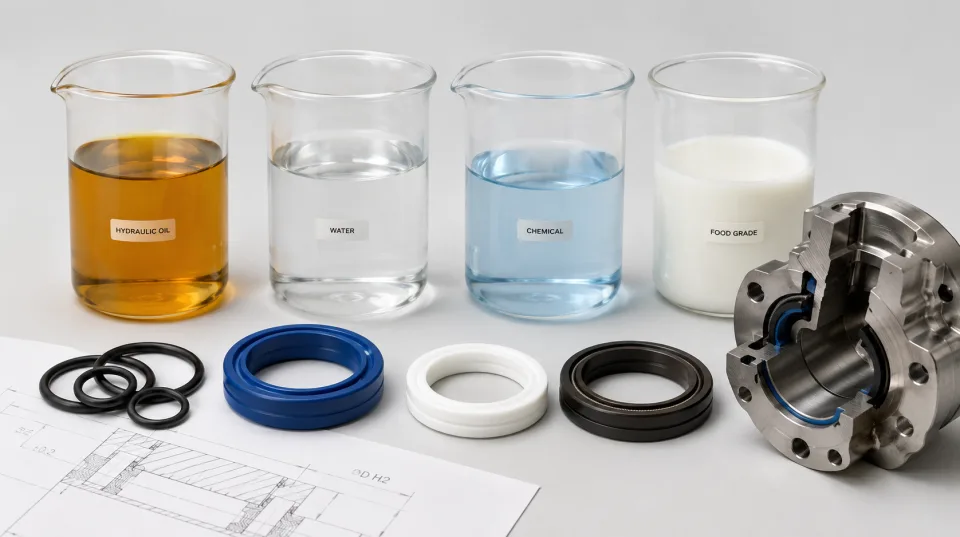
Selection of a seal should not begin solely with the dimension itself. In practice, equally important are: the working medium, temperature, pressure, speed of movement, type of operation and the method of installation. It is the working environment that largely determines whether a given material will retain its properties or quickly become damaged.
Different material groups are used for hydraulic oil, water, steam, process chemicals, fuels, greases or food products. The same seal profile may work properly in one application and in another very quickly lose tightness, swell, harden, crack or undergo excessive wear.
1. Why is the working medium so important?
The working medium is the substance the seal is in direct contact with during operation. It can be a liquid, gas, steam, lubricant, oil, fuel, chemical, detergent or a food product. Each of these environments can affect the seal material differently.
An improperly selected material can change its properties after a short operating time. The most common problems are:
- material swelling,
- hardening or loss of elasticity,
- surface cracking,
- delamination or crumbling,
- accelerated abrasion,
- loss of tightness,
- extrusion of the seal from the gap,
- reduced lifetime of the entire system.
For this reason, when selecting a seal you should always specify not only the dimension, but also the chemical and physical conditions in which the component will operate.
2. Seals for hydraulic oil and greases
Hydraulic oils and greases are among the most common working media in industrial systems, construction and agricultural machinery, presses, cylinders and production equipment.
In such applications materials often used include:
- NBR — a popular material for mineral oils and many standard applications,
- PU — a material with high abrasion resistance, often used in hydraulic power applications,
- FKM — chosen for higher temperatures or more demanding environments,
- PTFE — a low-friction material used in more demanding applications.
For hydraulic oils it is useful to specify the type of oil, operating temperature, pressure, speed of movement and whether the seal works statically, in reciprocating motion or rotationally.
3. Seals for water and steam
Water and steam require a different approach than mineral oils. Depending on temperature, pressure and composition of the medium, materials resistant to water, hot water, steam or cleaning agents used in the system are selected.
In water applications materials commonly considered include:
- EPDM — often used for water, hot water and steam,
- VMQ / silicone — used in selected temperature and food-grade applications,
- PTFE — used for demanding chemical or temperature conditions,
- FKM — used in selected applications, but not always the first choice for steam.
For steam it is particularly important to provide temperature, pressure and whether contact with steam is continuous or intermittent. Materials for short-term contact with hot water are selected differently than for continuous operation in pressurized steam.
4. Seals for process chemicals
For process chemicals, general terms like “chemical”, “acid”, “solvent” or “detergent” are often insufficient. The exact name of the substance, its concentration, temperature and exposure time to the seal are crucial.
For chemical applications, among others, the following may be used:
- FKM — for many oils, fuels and selected chemical media,
- EPDM — for selected water, steam and some chemical agents,
- PTFE — for broad chemical resistance and low friction,
- FFKM — in particularly demanding chemical and temperature applications,
- PEEK, POM, PA — as structural, guiding or support elements depending on operating conditions.
For inquiries regarding chemicals it is worth providing the safety data sheet of the medium, the trade name, concentration, operating temperature and whether the seal will be exposed to rinsing, cleaning or medium changes during the cycle.
5. Seals for fuels and diesel oils
Fuels, diesel, gasoline, fuel additives and blends with bio-components can affect elastomers in different ways. A material that performs well with hydraulic oil is not always suitable for fuels.
In such applications the following are often considered:
- FKM — frequently used for fuels and higher temperature demands,
- NBR — used in selected oil and fuel applications depending on conditions,
- PTFE — when low friction or high chemical resistance is required.
When enquiring, specify whether it concerns gasoline, diesel, fuel with additives, heating oil, gas, fuel mixtures or exposure to vapors.
6. Seals for the food industry
In the food industry, in addition to resistance to the medium, hygiene requirements, material approvals, ease of cleaning and resistance to cleaning agents are also important.
In such applications the following may be used, among others:
- VMQ / silicone — in selected food and temperature applications,
- EPDM — often used with water, steam and cleaning processes,
- FKM — for fats, oils and more demanding media,
- PTFE — for high chemical resistance and ease of cleaning.
For food applications provide not only the type of product but also temperature, cleaning method, detergents used and any requirements regarding food contact.
7. Temperature and material resistance
Even if a material is compatible with a given medium, temperature can significantly change its durability. High temperature accelerates material ageing, while low temperature can cause loss of elasticity.
In an inquiry it is useful to provide:
- minimum operating temperature,
- maximum operating temperature,
- peak temperature,
- duration of elevated temperature,
- frequency of temperature changes.
The same material may be acceptable for short-term exposure to high temperature, but not suitable for continuous operation under such conditions.
8. Pressure, speed and type of motion
The working medium is not the only factor determining seal selection. Mechanical operating parameters are also important, especially pressure, speed of movement and type of motion.
It should be specified whether the seal operates:
- statically,
- in reciprocating motion,
- in rotational motion,
- in oscillating motion,
- in continuous operation,
- in intermittent operation.
At high pressure it may be necessary to use a support ring. For dynamic motion, abrasion resistance, friction, lubrication and the condition of the mating surface are more important.
9. Method of installation and housing dimensions
Even a correctly chosen material may not function properly if the seal profile does not fit the housing. Therefore, in addition to the medium, provide the dimensions of the installation area.
The most important dimensional data are:
- shaft, piston rod or bore diameter,
- outer diameter of the housing,
- groove width,
- groove depth,
- housing height,
- assembly clearance,
- information about the installation method.
It is useful to attach a technical drawing, photo of the housing or the worn part. This helps to identify the profile faster and avoid errors resulting from measuring a deformed seal.
10. What data to provide in an inquiry?
To select a seal for the working medium, it is best to prepare as complete a set of technical information as possible.
In the inquiry it is worth providing:
- type of working medium,
- exact name of the substance or preparation,
- concentration of the medium, if applicable,
- minimum and maximum temperature,
- operating and maximum pressure,
- type of motion,
- speed of movement,
- housing dimensions,
- type of machine or equipment,
- information on continuous or intermittent operation,
- cleaning conditions of the system,
- requirements regarding food contact, if any,
- photo, technical drawing or a sample of the worn part.
11. What to do if we do not know the exact medium?
If the exact medium is not known, provide all available information: machine name, application, industry, process description, temperature and the appearance of the worn part. Sometimes the nature of the damage alone can indicate that the material was not resistant to the given environment.
Example symptoms of material incompatibility with the medium are:
- noticeable swelling of the seal,
- softening of the material,
- hardening and cracking,
- change of color,
- crumbling of the material,
- slippery or sticky surface,
- rapid loss of tightness after replacement.
In such cases a photo of the damaged part and information on how long after installation the problem occurred are particularly helpful.
Summary
Selecting a seal for the working medium requires taking into account not only the dimension, but also the chemical, temperature and mechanical conditions. Hydraulic oil, water, steam, fuel, process chemicals and food products may require completely different materials.
When enquiring, it is best to provide: the medium, temperature, pressure, type of motion, operating speed, housing dimensions and the expected sealing function. The more accurate the data provided, the easier it is to select a material and profile that will be resistant to the working environment and ensure adequate durability.
Need help selecting a seal?
Send medium, dimensions and operating conditions. We will prepare material selection guidance and execution options.