In many industrial plants a machine stoppage doesn’t begin with a major failure but with a minor issue: an oil leak, a pressure drop, contamination of the medium or overheating of a working component. Very often the source of such a problem is a technical seal that was poorly selected, wore out faster than expected or is operating beyond its real capabilities.
Properly selected seals are not merely consumable parts. In hydraulics, pneumatics, rotating assemblies and static applications they affect reliability, workplace safety, process quality and the predictability of maintenance.
1. Why do seals have such a large impact on downtime?
A seal usually works where pressure, motion, temperature, the working medium and the installation geometry meet. If one of these elements is overlooked during selection, even a part that looks correct can quickly lose its tightness.
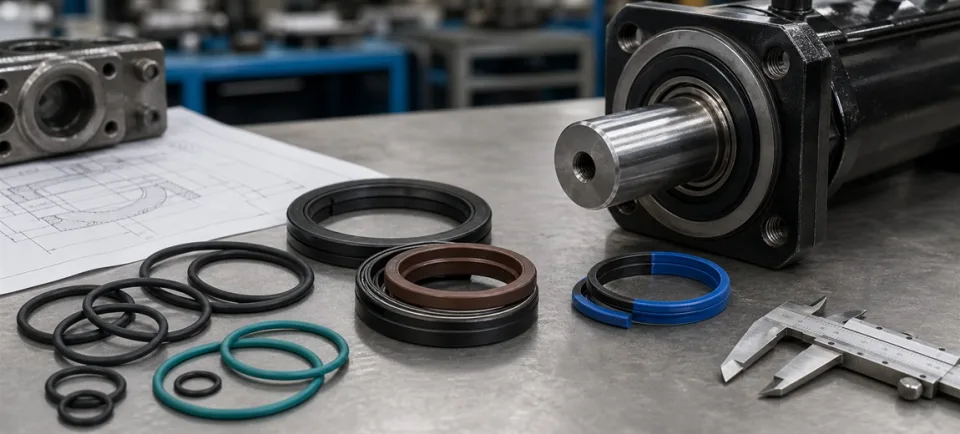
The problem can concern various types of seals, including O-rings, oil seals (simmerings), rod seals, wiper rings, guide and support rings. In every case the failure of one small element can stop a cylinder, pump, gearbox, press, packaging line or a machine tool.
2. The most common consequences of poorly selected seals
An incorrectly selected seal can cause more than just a leak. In production practice the consequences are often broader and tend to accumulate gradually.
- Unplanned machine stoppage due to loss of tightness or pressure drop.
- Contamination of the product or the workplace, especially with oils, lubricants, coolants and chemical media.
- Accelerated wear of mating components, for example shafts, piston rods, bushings or housings.
- Increased temperature and friction when the seal material or geometry does not match the type of motion.
- Repeated service interventions that engage maintenance staff and generate labor costs.
- Risk of damage to additional assemblies if a leak or contamination is not detected early enough.
3. Material selection for the medium and temperature
One of the basic conditions for reliability is matching the seal material to the working medium and temperature. Different requirements apply to hydraulic oil, water, steam, coolant, fuel, grease, compressed air or chemical agents.
In typical industrial applications materials such as NBR, FKM, EPDM, VMQ, PU, PTFE, FFKM and engineering plastics used in guide elements — for example POM, PA or PEEK — are often evaluated. Each has different properties and must be checked against the operating conditions.
- NBR is commonly used with oils and greases, depending on temperature and medium composition.
- FKM can be considered for higher temperatures and demanding media, but compatibility must be verified.
- EPDM is used with water, steam or certain chemical media, but is not a universal material for oils.
- PU is popular in hydraulic power applications, especially where mechanical resistance and operation under pressure are important.
- PTFE may be suitable for low friction, selected chemicals and applications with specific motion requirements.
4. The importance of pressure, type of motion and speed
A static seal behaves differently than a seal in reciprocating, rotating or oscillating motion. Therefore the same material and similar dimension do not automatically mean the same durability in different applications.
In hydraulic power systems, among other factors, working pressure, pressure spikes, piston rod speed, assembly clearance and presence of contaminants are important. In rotating applications, peripheral speed, shaft condition, lubrication, temperature and radial runout play a major role.
5. Inspect the housing before replacing a seal
Simply replacing a seal with a new one does not always solve the problem. If the housing is worn, contaminated or damaged, the new seal may fail very quickly.
- Check the condition of the mating surface: shaft, piston rod, bushing, cylinder or bore.
- Verify roughness and look for scratches, pitting, corrosion or signs of seizure.
- Assess assembly clearance and the possibility of extrusion of the seal under pressure.
- Remove contaminants, metal filings, old rubber fragments and medium residues.
- Check whether the seal was damaged during installation.
6. Typical signs not to ignore
Early signs of seal wear allow planning service before an unplanned line stoppage occurs. Maintenance should pay attention especially to recurring signals of system degradation.
- Visible leak of oil, grease, coolant or another medium.
- Pressure drop, slower cylinder action or unstable movement of the working element.
- Increase in noise, vibration, temperature or friction around the seal area.
- Contamination on the piston rod, shaft or near the wiper ring.
- Frequent damage to the same component despite regular replacement.
- Signs of cracking, hardening, swelling, abrasion or crumbling of the material.
7. Plan replacements instead of firefighting failures
The greatest losses occur when a seal fails during production and the appropriate part is not available in stock. That is why it is worth building a list of critical seals for the most important machines and setting minimum stock levels for them.
In practice it is helpful to mark assemblies where a seal failure stops the entire line, affects safety or causes costly product contamination. For such locations it is worth having substitutes, dimensional documentation or samples ready for quick reproduction.
8. When to use a custom-made seal?
Off-the-shelf seals are not always the best solution. In older machines, non-standard housings, short production runs, modernizations and emergency repairs a seal made to size, from a sample or drawing is often needed.
Custom solutions can help when a standard part has too short a service life, does not fit the available installation or you need to quickly reproduce a part that is no longer regularly sold. In such cases it is particularly important to provide complete application data, not just external and internal dimensions.
9. What information to provide in an inquiry?
The more accurate information reaches the seal supplier, the higher the chance of selecting a solution that will reduce the risk of another failure. This applies to both new projects and maintenance repairs.
- Type of seal or photos of the component from several sides.
- Dimensions: inner diameter, outer diameter, height, cross-section, groove width or installation dimensions.
- Working medium, temperature, pressure and any pressure spikes.
- Type of motion: static, reciprocating, rotating or oscillating.
- Motion speed, operating frequency and expected production cycle.
- Material of the previous seal, if known.
- Information about previous failures, symptoms and service life of the prior element.
- Technical drawing, sample or part number, if available.
- Expected quantity, delivery timeframe and the part’s importance for production continuity.
10. Collaboration between purchasing, maintenance and engineering
Reducing downtime requires not only buying parts but also information flow. Technical purchasing should know which seals are critical, maintenance should document failure symptoms, and technologists or designers should account for operating conditions and installation constraints.
Thanks to this the seal supplier can better assess whether a standard O-ring, rod seal, oil seal, wiper ring, guide element, PTFE seal, polyurethane solution or a custom-made design is needed.
Summary
Proper technical seals help reduce production downtime because they lower the risk of leaks, pressure drops, contamination and repetitive failures. Key factors are selecting the right material, geometry and seal type for the actual machine operating conditions.
The best results come from a systemic approach: failure analysis, housing inspection, documentation of critical parts, stocking key seals and providing full technical data when inquiring. This way a seal stops being a random spare part and becomes an element of conscious maintenance of production continuity.
Need help selecting a seal?
Send medium, dimensions and operating conditions. We will prepare material selection guidance and execution options.